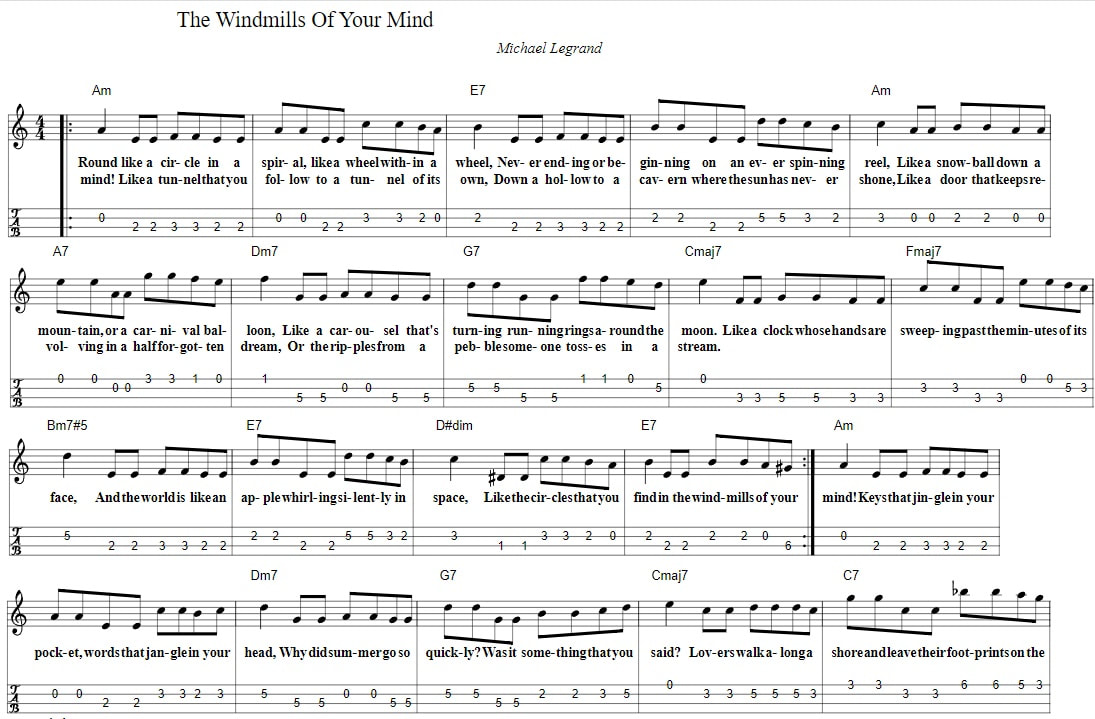
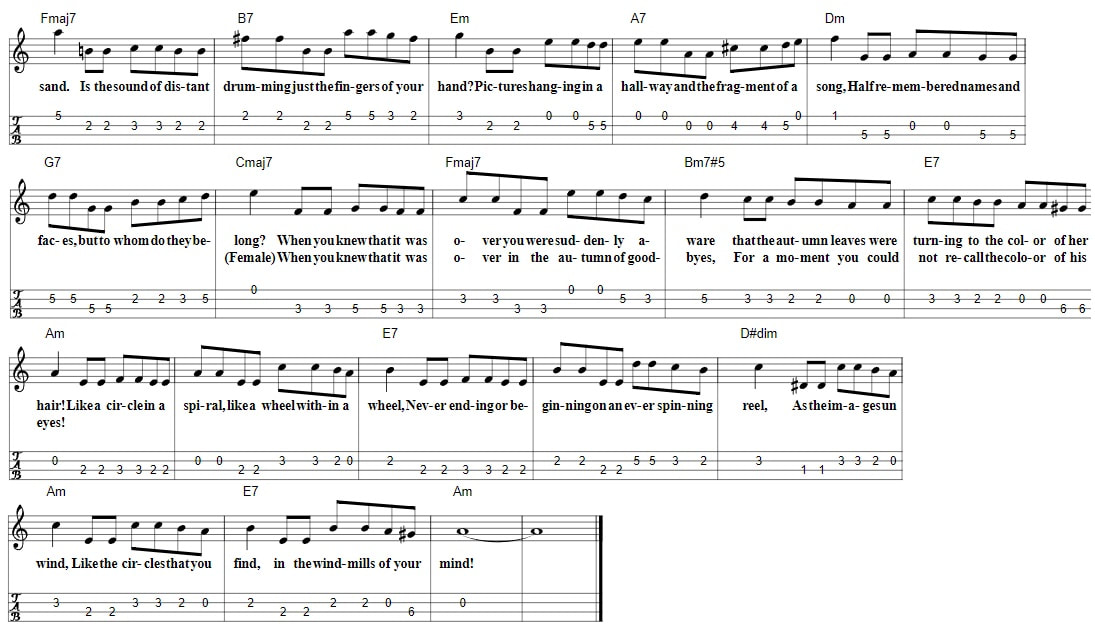
The Windmills Of Your Mind Mandolin Tab With Chords
The Windmills Of Your Mind Mandolin / Tenor Banjo Tab With Chords In The Key Of C.
Playing "The Windmills of Your Mind" by Michel Legrand on the piano is a great choice, as it's a beautiful and atmospheric song. While the original key is often E minor, it can be easily transposed to C major for a more beginner-friendly experience. Here's a guide to help you play it.
Song Structure
The song is a waltz, so it has a 3/4 time signature. It's known for its winding, circular melody, which is reflected in the chord changes. The structure is generally:
Chords in C Major
The chords for the C major version are a mix of major, minor, and seventh chords. These are some of the key chords you'll need:
Chord Progressions
Here are the basic chord progressions for each section of the song. For the left hand, you can play the root note of the chord in a simple pattern, and for the right hand, you can play the full chord or the melody.
Verse
Playing Tips for Piano
Song Structure
The song is a waltz, so it has a 3/4 time signature. It's known for its winding, circular melody, which is reflected in the chord changes. The structure is generally:
- Verse 1
- Verse 2
- Chorus
- Bridge
- Verse 3
- Chorus
Chords in C Major
The chords for the C major version are a mix of major, minor, and seventh chords. These are some of the key chords you'll need:
- C Major: C - E - G
- A minor: A - C - E
- D minor: D - F - A
- G7: G - B - D - F
- F Major: F - A - C
- C7: C - E - G - B♭
- E minor: E - G - B
Chord Progressions
Here are the basic chord progressions for each section of the song. For the left hand, you can play the root note of the chord in a simple pattern, and for the right hand, you can play the full chord or the melody.
Verse
- "Round, like a circle in a spiral..."
- C - Dm - Em - C - F - C - G7 - C
- "Like a clock whose hands are sweeping..."
- F - C - G7 - C - F - C - G7 - C
- "Pictures hanging in a hallway..."
- Am - Dm - G7 - C - F - Dm - G7 - C
Playing Tips for Piano
- The Left Hand: For a simple accompaniment, use your left hand to play the root note of each chord on the first beat of each measure. You can then add the other notes of the chord on the following beats to create a waltz rhythm (root, chord, chord).
- The Right Hand: The right hand can play the melody. The melody line is very flowing and uses a lot of arpeggiated or broken chords. You can use online sheet music or tutorials to learn the exact melody notes.
- Dynamics: The song should have a "flowing" feel, like a carousel or a windmill. Use dynamics to create a sense of movement. Start softly, build up during the chorus, and then ease back down.
- Transposition: If you find the C major version difficult, you can easily find simplified arrangements online or use a different key. For a slightly different feel, you could play it in the key of A minor, which is the relative minor of C major.